
As the years go by, new technological ways to improve production and obtain a better control of fertigation and plant nutrition of our crops are appearing. One strategy that our company, Agran Liquid Technology, has been using for more than 6 years is the measurement of petiole extract using sap ionometers. Therefore, today we want to tell you why sap analysis helps crops.
This system allows to know almost instantly the nutrients concentrated in the cell juice of the extracted sap. This provides more relevant information to define a strategy for the crop.
What is sap analysis measurement?
Sap analysis or petiole sap extraction is a simple and practical technique to obtain, directly from the plant and in a few minutes. Relevant information is obtained about nutrients accumulated in the cell juice or sap of any plant.
Under this technique, values collected in ppm or mg/L of the following nutrients can be obtained:
- Nitrogen in the form of nitrate (NO3-), measured in mg/L
- Potassium (K2O) measured in mg/L
- Calcium (Ca2+) measured in mg/L
- Sodium (Na+) measured in mg/L
- pH
- Conductivity (EC) measured in mS/cm
- º Brix (%) or concentration of sugars
The difference between this diagnostic method and laboratory foliar analysis is that it only allows the reading of soluble (mobile) nutrients, instead of all types of nutrient status, including insoluble forms. Therefore, it is very interesting because its reading resembles, comparatively, a real blood analysis, but in vegetables, obtainingsensitive and important information for decision making.
Advantages of the sap analysis tool
Why does sap analysis help in crops? Let's learn about its advantages:
- Get to know in situ the nutrient pantry of the crop.
- Increases information prior to foliar treatments or preparation of fertilizer tanks for fertigation.
- It anticipates possible nutritional deficiencies or mismatches in fertilization.
What is the relationship between nutrients?
Any crop maintains a constant balance between cations (positively charged nutrients) and anions (negatively charged nutrients). The imbalance of one nutrient can affect the rest and, as a result, production losses, nutritional deficiencies or imbalances can occur. For example, potassium (K+) competes directly with the concentration of calcium (Ca2+), sodium (Na+) or magnesium (Mg2+), so an excess of this nutrient negatively affects the assimilation of the rest.
Depending on the phenological or growth stage of the crop, the concentration of nutrients will vary. At the beginning of the crop (sprouting to fruit production), it is usual to have higher accumulated reserves of nitrogen and lower accumulation of potassium. However, as the stock of elements that absorb photoassimilates (carbon and sugars) increases, the tendency of nitrogen is to decrease and potassium to increase.
This nitrogen is not necessarily reduced by a lower input in fertigation, but also by an increased activity of the plant. This will rapidly transform this element into carbon elements: proteins, amino acids and sugars. As a result, the º Brix in sap increases progressively in anticipation of the greater accumulation of these elements in the fruit.
An example of this can be seen in these images:
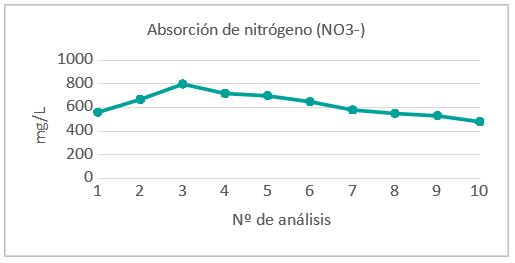
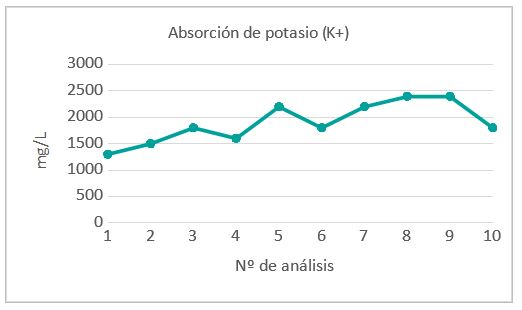
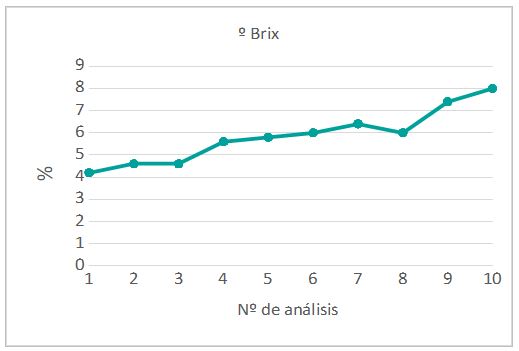
- As can be seen, the trend in the sequence of analyses has been a progressive decrease in the accumulation of nitrogen (NO3-) and a constant increase in both potassium (K+) and Brix.
- Each crop, variety and form of cultivation has its own values, so it is necessary to have a solid database to adjust the parameters as much as possible.
- For all these reasons, Agran's team offers its customers crop monitoring through sap analysis, a very important tool for decision making in any type of crop.