Leanri: +40.000 kg/ha en la peor campaña en 16 años. cuando el manejo marca la diferencia en cítricos

Leanri

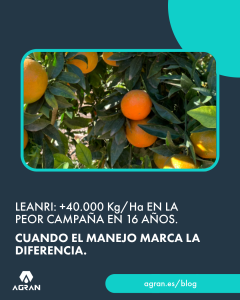
Leanri: +40.000 kg/ha en la peor campaña en 16 años.

Cuando el manejo marca la diferencia en cítricos

La campaña 2024/25 se perfila como una de las más difíciles para el sector citrícola en las últimas décadas. Las altas temperaturas estivales, la falta de frío invernal y los episodios de estrés hídrico han afectado gravemente la floración, el cuajado y el desarrollo del fruto en muchas variedades de mandarinas y naranjas.
En este contexto, los productores de Leanri, una variedad especialmente sensible a los desequilibrios fisiológicos, prevén caídas de producción de hasta el 50%, con rendimientos medios en torno a 18.000 kg/ha.

Sin embargo, en fincas manejadas bajo el protocolo Agran Liquid Technology, los resultados son radicalmente diferentes: rendimientos estimados cercanos a los 40.000 kg/ha, manteniendo calibre, uniformidad y sanidad del árbol.

La diferencia está en el manejo fisiológico integral, que va más allá de la simple nutrición.

???? 1. Postcosecha: preparación para el siguiente ciclo

Tras la recolección, el árbol entra en una fase clave de recuperación. En este momento, la aplicación de DEFEND (2 L/ha) junto a ácido giberélico estimula la regeneración de tejidos, activa los procesos enzimáticos y promueve una rápida formación de reservas.
Este paso es esencial para llegar al invierno con un árbol equilibrado y con buena brotación potencial para la próxima campaña.

???? 2. Prefloración: vigor controlado y raíces activas

En prefloración, el objetivo es preparar al árbol para una floración abundante y equilibrada, evitando un exceso vegetativo.
El protocolo combina aplicaciones por riego y vía foliar:

  • Por riego: AGRAN AMINO (2 L/ha) + RENOVO (2,5 L/ha) + SURF MAX (2,5 L/ha)
    → mejora la estructura radicular, promueve la microbiota del suelo y optimiza la absorción de nutrientes.
  • Vía foliar: MAGNAMIX (1,5 L/ha) + VELOCITY (3 L/ha)
    → activa la fotosíntesis, mejora la translocación de nutrientes y favorece la diferenciación floral.

El resultado: un árbol fisiológicamente activo, con raíces sanas y una floración más uniforme.

???? 3. Floración: asegurar el cuajado

Durante la floración, mantener la energía metabólica y la actividad hormonal es determinante para lograr un buen cuajado.
El tratamiento con AUGEO (2 L/ha) + CELERIS (2 L/ha) + MAGNAMIX (1 L/ha) + ácido giberélico refuerza la división celular, favorece la polinización y mejora la retención de flores y frutos recién cuajados.
Esta fase define en gran medida la productividad final del cultivo.

???? 4. Desarrollo del fruto: calibre y eficiencia

En la fase de engorde, el foco pasa al equilibrio entre crecimiento y calidad.
La combinación de MAGNAMIX (2,5 L/ha) + MOMENTO (2,5 L/ha) + SURF MAX (2 L/ha) garantiza una óptima asimilación de calcio, potasio y magnesio, mejorando la turgencia y el calibre.
Además, SURF MAX mejora la penetración y aprovechamiento de los tratamientos, reduciendo pérdidas por escorrentía y asegurando la eficacia.

???? Resultados visibles: fisiología equilibrada y alto rendimiento

Los productores que han seguido este programa reportan árboles con:

  • Mayor densidad foliar y verde intenso.
  • Cuajado uniforme incluso tras condiciones de estrés.
  • Frutos con calibre superior y sin signos de deshidratación o caída prematura.
  • Expectativas de más de 40.000 kg/ha, frente a los 18.000 kg/ha observados en otras fincas de la misma variedad.

???? Conclusión: la tecnología líquida marca la diferencia

En campañas adversas, el éxito no depende del azar, sino del manejo.
El enfoque fisiológico de Agran Liquid Technology —basado en soluciones líquidas de alta biodisponibilidad y acción preventiva— permite mantener la productividad incluso bajo condiciones de estrés abiótico.

Porque la diferencia entre una campaña difícil y una campaña rentable, empieza en cómo se prepara el árbol.
fertilizantes en narano y mandarinoLEANRI

Para más información, ponte en contacto con nuestro departamento técnico o visita nuestra web: www.agran.es o llámanos al 960 11 79 13

Read our privacy policy.

Cómo evitar los efectos del encharcamiento en los cultivos tras lluvias torrenciales

Cómo evitar los efectos del encharcamiento en los cultivos tras lluvias torrenciales

Las lluvias torrenciales de las últimas semanas han puesto a prueba la resiliencia de muchos cultivos en nuestro país. Aunque el agua es un recurso imprescindible para la agricultura, cuando llega en exceso y en poco tiempo se convierte en una seria amenaza para la productividad. Los campos anegados o con abundantes acumulaciones de agua generan condiciones adversas que favorecen el desarrollo de enfermedades y ponen en riesgo la viabilidad de la plantación.

En este artículo queremos explicar cuáles son los principales problemas derivados del encharcamiento, cómo afectan al cultivo y de qué manera SURF MAX ofrece una solución eficaz para mitigar estos daños.

El problema del encharcamiento

Cuando el suelo queda saturado de agua, se produce un fenómeno de asfixia radicular: las raíces no pueden acceder al oxígeno necesario para mantener su actividad metabólica. Esto limita la respiración celular y reduce la energía disponible para la planta, que entra en una situación de estrés.

A ello se suma que los encharcamientos favorecen la proliferación de hongos y bacterias patógenas, responsables de pudriciones y enfermedades radiculares que pueden comprometer todo el ciclo productivo.

El exceso de agua también afecta a la disponibilidad y absorción de nutrientes. Muchos elementos esenciales, como el nitrógeno, se lixivian o quedan en formas menos aprovechables, generando deficiencias que debilitan el cultivo.

Finalmente, los suelos que permanecen inundados durante días muestran falta de uniformidad en el desarrollo de las plantas, pérdidas de densidad de cultivo y, en los casos más graves, muerte de plantas completas. Todo ello se traduce en un impacto directo sobre la rentabilidad.

Una solución tecnológica: SURF MAX

Ante este tipo de situaciones, es clave contar con herramientas que ayuden a restablecer el equilibrio hídrico del suelo y reduzcan los riesgos asociados.

SURF MAX es un producto desarrollado por Agran Liquid Technology con acción tensioactiva, diseñado para mejorar la dinámica del agua en el suelo. Su aplicación favorece una infiltración más rápida y homogénea, evitando la formación de charcos y acumulaciones superficiales.

Gracias a esta acción:

  • El suelo recupera antes sus condiciones de aireación.
  • Las raíces permanecen oxigenadas, reduciendo el riesgo de asfixia.
  • Se limita la proliferación de microorganismos patógenos asociados al exceso de humedad.
  • Se optimiza el aprovechamiento del agua y se reduce la escorrentía, minimizando pérdidas.

Otro aspecto relevante es que SURF MAX es compatible con fertilizantes y fitosanitarios, lo que permite integrarlo fácilmente en el plan de manejo del agricultor sin interferencias ni complicaciones logísticas.

Beneficios directos en campo

El uso de SURF MAX aporta beneficios visibles y medibles en las explotaciones:

  • Mayor seguridad tras lluvias extremas: el producto actúa como herramienta de prevención frente a los efectos negativos del encharcamiento.
  • Mejor desarrollo radicular: al mantener la oxigenación, se favorece un sistema radicular activo y saludable.
  • Mayor uniformidad en el cultivo: las plantas se desarrollan de forma más homogénea, reduciendo mermas de producción.
  • Reducción de pérdidas económicas: se evitan daños irreversibles en la plantación y se protege el rendimiento.

Conclusión

El cambio climático está aumentando la frecuencia e intensidad de los episodios de lluvias torrenciales. Los agricultores se enfrentan al reto de gestionar situaciones de exceso hídrico que antes eran menos comunes, pero que ahora forman parte del día a día.

En este contexto, contar con soluciones como SURF MAX resulta estratégico. Su capacidad para mejorar la infiltración del agua, mantener el suelo aireado y reducir los riesgos asociados al encharcamiento lo convierte en una herramienta imprescindible para asegurar la continuidad y rentabilidad de los cultivos.

En Agran Liquid Technology trabajamos para ofrecer productos de grado farmacológico que van más allá de la nutrición y ayudan al agricultor a proteger sus cultivos frente al estrés abiótico. Porque cada gota de agua debe ser un recurso, no un problema.

Pulsa para ver la publicción


Read our privacy policy.

X-Tend reduces nitrogen dependence

X-Tend, the biostimulant that reduces dependence on nitrogen

The cereal season has been affected by the increase in fertilizer prices and costs related to the agricultural sector. As a consequence of this situation, many farmers have had to do without bottom and top dressing fertilizers. Therefore, from Agran we recommend X-Tend, an effective solution that makes the most of soil nutrients and achieves very productive results.

X-Tend increases the availability of nitrogen and other macroelements with technological carbon sources.

X-Tend is a liquid biostimulant developed in the United States based on Micro Carbon Technology. It can be mixed with solid and liquid fertilizers to achieve a higher percentage of nutrients absorbed by the plant, greater root development and less sensitivity to drought and weather conditions. 

When the product is applied to the soil and roots, signals are activated in the plant that promote the massive entry of nutrients into the interior of the cells, with special emphasis on nitrogen in the form of nitrate and phosphorus. Thus, the cereal has greater resources to produce sugars, proteins and carbohydrates, achieving more productive crops and a positive return on investment for the farmer.

x-tend

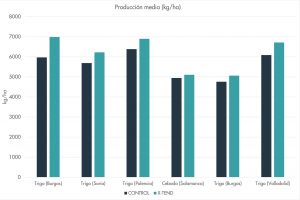
The benefits on the plant are observed from the first weeks of application, where the differences between treated and untreated cereals are clearly visible. Stronger, greener and denser plants that stoically withstand any kind of stress and have more energy available to produce more and better.

Agran points out the importance of using advanced carbon technologies as a source to protect and improve the fertility of agricultural land.

It is very important to feed our soils with tools that allow us to multiply their native microbiology, reducing the fragility of cereals to weather changes, drought or stress caused by pests and diseases. 

With more efficient fertilizer management and continuous soil enrichment, a multiplier effect is achieved. This makes it possible to progressively increase production after each season.

???????? X-TEND

How to increase flowering and fruit set of melon and watermelon?

flowering and fruit set

Llega la primavera y con ello la campaña de melón y sandía. Y, para obtener una buena cosecha de estos cultivos hay dos factores que influyen en gran medida además de las circunstancias climáticas y las nutricionales: la floración y el cuajado.

En este sentido, desde Agran ayudamos a conocer cómo aumentar la floración y el cuajado del melón y sandía a través de Augeo y Boramol.

Augeo como estimulante de la floración

Gracias al contenido en promotores de la floración naturales, como auxinas, citoquininas y florotaninos, Augeo es un promotor ideal de floración y cuajado de frutos. Su aplicación en esta fase del cultivo influye directamente sobre la mejora de la calidad del polen y facilita la fecundación por parte de abejas y abejorros.

La aplicación de Augeo foliar y en fertirrigación actúa directamente sobre:

  • Balance energético de la planta.
  • Apertura de yemas y flores femeninas.
  • Aumento de la calidad de polen en flores masculinas.
  • Reduce momentos puntuales de estrés por climatología, sequía, inundaciones o estrés biótico.
  • Contiene compuestos fitoactivos y azúcares que mejoran la producción, calibre y calidad de los frutos.

???????? https://agran.es/productos/augeo/ 

Boramol y la importancia del boro en la floración

El Boro y el molibdeno es un micronutriente fundamental tanto para la sandía como para el melón ya que interviene, entre otras, en la floración, el tamaño, la fertilidad o la calidad de los frutos. 

Boramol es una suspensión concentrada de boro y molibdeno diseñada para aportar ambos micronutrientes en la fase de prefloración, floración y formación de frutos. En esta etapa, las necesidades de boro son mucho más altas que está vinculado con una mayor calidad de polen y acumulación de reservas energéticas.

La aplicación en fertirrigación de Boramol ofrece las siguientes ventajas en melón y sandía:

  • Fundamental en los principales procesos fisiológicos de la planta como son la división y el crecimiento celular.
  • Desempeña un papel clave en  la polinización y cuajado de los frutos.
  • Boro aumenta la viabilidad de los granos de polen y reduce la oxidación del ácido indolacético, una auxina natural.
  • Aumenta la formación de aminoácidos gracias a la transformación del nitrógeno de la planta en proteínas.

Gracias al aporte de estos micronutrientes, se obtiene un mayor porcentaje de cuaje y la calidad de los frutos se ve aumentada. 

???????? https://agran.es/productos/boramol/ 

How to stimulate sprouting of citrus trees

how to stimulate citrus fruit sprouting

Citrus budbreak is the most important moment in the beginning of the crop and, in the case of citrus, spring budbreak is crucial. This is so because, depending on how it has developed, the productivity and quality of the fruit can achieve greater or lesser efficiency. In other words, the more bud break, the better the harvest results

For all these reasons, it is recommended to apply stimulating solutions after harvesting the fruit in order to obtain the best possible sprouting for the following production.

Factors involved in citrus sprouting.

There are several factors involved in citrus sprouting:

  • The climate
  • The amount
  • The time of permanence of the fruit on the tree

In that sense, the residence time is the most important because the fruits promote gibberellin synthesis and bud transport, thus preventing sprouting and altering differentiation. 

Velocity, sprouting activator solution

Velocity is a 15-5-5 NPK solution with micronutrients indicated for foliar application from the early stages of crop development.

In addition, it provides a great stimulus in the crop, increasing cell hydration and the beginning of sprouting processes. It promotes the increase of reserves, available energy and final production. 

Application advantages of Velocity:

  • Promotes faster, more uniform and vigorous sprouting.
  • Responds quickly and effectively to stressful situations or lack of development.
  • Increases the effectiveness of foliar nutritional and phytosanitary treatments.
  • Contains surfactants that provide immediate assimilation and reduce losses due to washing and runoff.
  • Activates the natural formation of enzymes, phytohormones and amino acids involved in cell division.
  • There is no risk of burns or staining of fruits and leaves.

For citrus, Velocity requiresapplications every 30 days in mixture with the phytosanitary treatments and in doses of 5-10 L/ha from sprouting. 

???? ➡️ VELOCITY: https://agran.es/productos/velocity/

How to promote the cultivation of berries

how to promote the cultivation of berries

The optimum growing temperature for berries ranges between 23 and 25 ºC. However, most varieties, such as strawberries, need cold winter temperatures to achieve good production results.

Thus, as far as cultivation is concerned, berries require loose soils in which there are no problems of waterlogging, as this can lead to the rapid death of a large number of plants. And, if we talk about fertilization, do not overdo it with the amounts because these plants are sensitive to salinity.

In addition, another peculiarity of berries, and in particular strawberries, is that they are very demanding in terms of pH. This is due to the fact that these crops do not tolerate calcareous or very low pH soils.

Breakout, the solution for the cultivation of berries

Of all strawberry crops, berries require more specific soils. For this reason, it is important to control soil moisture so that the crop can grow in good conditions and quickly.

To achieve high yields, strawberries are sensitive to stimulant treatments that favor continuous flower production and initial fruit set. For this reason, Agran recommends the use of Breakout.

The use of Breakout is recommended in moments or phenological phases of the crop where it is desired to stimulate the natural production of phytohormones related to auxins and cytokinins, such as sprouting, bud formation and flowering.

In addition, thanks to the phosphorus complexed with Micro Carbon Technology it contains, it provides the necessary stimulus to increase the metabolic and photosynthetic rate of the crop and to favor the emergence from dormancy and environmental stress.


Advantages of using Breakout

In this sense, the advantages that Breakout brings to berry cultivation are fundamental.

???? Estimula la salida de yemas, el crecimiento lateral de tallos y hojas y aumenta la densidad vegetativa del cultivo.
???? Potencia la floración y salida homogénea de flores, mejorando la calidad del polen y su fecundación.
???? Aumenta el grosor y longitud del peciolo, permitiendo que el fruto aumente su exposición a la luz, engorde y madure más rápidamente.
???? Es compatibles son aplicaciones insecticidas, fitosanitarias y formulaciones de cobre

???? ➡️ BREAKOUT: Potenciador fenológico en base a la inducción natural de citoquinas y auxinas.

Solutions for citrus ripening

solutions for the ripening of citrus fruits

Autumn is the ideal time to carry out both the ripening and harvesting of citrus fruits. Oranges, tangerines, grapefruit, lemons or clementines are fruits that find their ideal season with the cold and with the farewell of summer.

The Organization of Consumers and Users (OCU) includes the entire citrus family in the best foods for this season. Its vitamin and mineral contribution makes citrus a vital food to overcome the autumn day to day.

Arriving at this time of the year with citrus fruits ready for harvesting is essential. That is why, in this article we tell you how in Agran.es you will find the necessary impulse for citrus fruits to be one hundred percent ready.


Fructus, the solution for the ripening of your citrus fruits

The ripening process is the most important step prior to harvesting. Controlling even the smallest detail can make a difference in order to have a spectacular product. To achieve this, Agran.es recommends the use of Fructus.

The mixture of phosphorus and potassium makes this liquid solution an element that helps to accelerate and promote the fattening process. In addition, itactivates and induces ripening by increasing the firmness or hardness values of the fruits themselves.

Despite these advantages, Fructus is a very simple product to use. Fully liquid, Fructus is easy and safe to use. In addition, it contains no sulfates, no chlorides and no nitrates.


Recommended doses of Fructus

If the maturation process is vital, it is also vital to know how to use this type of product in the right measure.

In the case of citrus, the recommended dose is divided into two parts. The first one depends on whether we make a foliar application. In that sense, the most correct use is between 2 or 4 applications of 300 or 500 cc/hl per season every 20 days from the beginning of the fruit development process.


???? ➡️ FRUCTUShighly concentrated liquid solution of phosphorus and potassium


How to increase sugar content in fruits

increase sugars in fruits

Summer crops such as fruit trees, melon and watermelon or industrial tomatoes are characterized by an important dependence on the sugar content of the fruit. These are known as º Brix, a factor that serves to know the total percentage of dry matter (generally sugars such as sucrose) and that we can measure in the fruit, the sap of the plant or even the soil. In this article we tell you what mechanisms are involved and how to increase the sugar content in fruits.

Potassium has always been linked to sugar production and production and transport of sugarsThe reality is that there are many more factors involved in obtaining a higher amount of sugar (º Brix) and increased sweetness in the fruit.


Production of sugars by the plant

The process of production of sugars and photoassimilates by the plant is quite complex and requires the synchronization of many enzymes, biological and photosynthetic processes. Although many times attempts have been made to advance the process with the exogenous application of sugars (table sugar, for example), the reality tells us that positive results are not obtained.

At the biochemical level, the plant obtains sugars from the photosynthesis process, transforming starch and fructans into sugars such as sucrose from the enzyme amylase. However, this process slows down if the levels of potassium, boron or phosphorus, among others, are not at optimal levels and readily available to the plant.


Indispensable elements in the manufacture and transport of sugars in plants

In order to know how to increase the sugar content in fruits, it is necessary and essential to know the importance of the following elements.

Sol

It is not an element in the periodic table, but it is one of the most important factors in the manufacture of sugars. Light, together with water, favors photosynthesis processes, without which nutrients would cease to be important. The combination of good lighting and proper nutrition allows maximum yields to be obtained.

Phosphorus

Phosphorus is involved in the manufacture of energy within the plant, being an indispensable component in obtaining cellular energy (ATP). Therefore, it is involved in the manufacture of sugars and has special importance in obtaining º Brix by the plant.

Potassium

Potassium is the element that regulates the water balance of the plant. Its contribution ensures high yields in the crop and is involved both in the production of sugars and in their transport to the root and fruit.

This element is responsible for the production of antioxidant substances and elements that give color to fruits, such as lycopene in industrial tomatoes.

Boron

Boron is a microelement that regulates phytohormone activity and is involved in the movement of sugars to the fruit and root. Therefore, it is important to combine phosphorus, boron and potassium nutrition at ripening to achieve the highest possible sugar accumulation.

Subsequently, this element helps in the mobility of photoassimilates to the roots to generate reserves for next year, in the case of tree crops.


Products that help the plant to increase º Brix in fruits

At times when nutrition does not provide maximum results, the use of specific biostimulants and correctors can meet the crop's demand at specific times.

???? ➡️ SUPER K: potassium 40% w/w complexed with Micro Carbon Technology special fertigation technology

???? ➡️ PHOS-MAX: ultra-concentrated phosphorus complexed with Micro Carbon Technology to promote energy transfer (ATP) and manufacture sugars

???? ➡️ COLORO: potassium 20% w/w with fattening and ripening inducers (cytokinins and gibberellins) and certified organic.

???? ➡️ YIELD-MAX: maturation enhancer with abscisic acid precursors.

???? ➡️ FRUCTUS: phosphorus (23.5% w/w) + potassium (26.0%) liquid and ultra concentrated with cell filling precursors.

???? ➡️BORAMOL: boron (9.0% w/w) + molybdenum (0.75% w/w) sugar mobilizer.

If we detect a low presence of sugars in the sap (measured with a refractometer in petiole) and the weather is suitable, we recommend the application of the following corrective treatment

  • Fertigation: PHOS-MAX (3 L/ha) + BORAMOL (1,5 L/ha)

If we want to act with everything to promote a rapid rise in Brix, we will apply phosphorus, potassium and boron together.

  • Foliar: FRUCTUS (300 cc/hl) + BORAMOL (200 cc/hl)

At the same time, if potassium levels in the plant are low, we will help to maintain adequate levels with the following treatment:

  • Fertigation: SUPER K (3 L/ha) + BORAMOL (1.5 L/ha)
  • Foliar: YIELD-MAX (300 cc/hl) + PHOS-MAX (150 cc/hl)

If we work in organic agriculture, we will use COLORO (300-500 cc/hl) in foliar application or 3-5 L/ha in fertigation.